Posts Tagged “innovation”

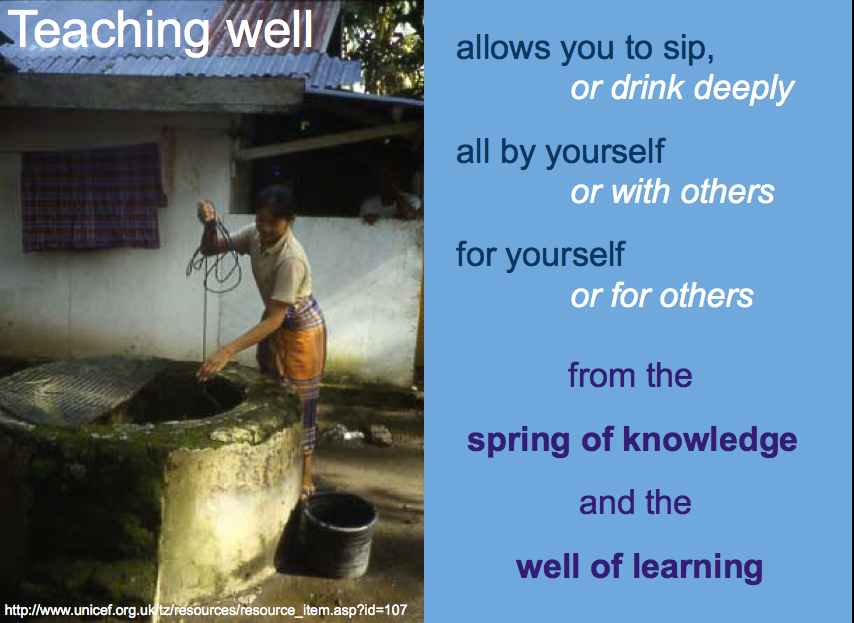
Last spring I saw a tweet about a collaborative venture called “Teaching Well” that was part of the work Darren Kuropatwa (@dkuropatwa) was doing with facilitating PLP work. Basically the idea was that one person started a metaphor/contrast about teaching and the other person finished it. There were some amazing contrasts and pairs of slides that not only showed the creativity of the teachers involved but also the philosophies and thoughts they have about teaching. I wasn’t officially part of the PLP, but Darren let me submit a slide anyway. (See the idea with many links explained here by Tania Sheko.)

Here’s mine.

Teachingwell

It clearly shows I believe teachers have to be learners, and in rereading it, I think that it pretty much encompasses all that I believe about teaching.

Teachers can teach shallowly, to simply pass the tests or we can teach for deep understanding that allows students to ask new questions and thirst for more; we can do it alone or we can collaborate and share with our colleagues; we can do it because we want to make a difference, we want to help kids, we relish the AH-HA moments in our students, we enjoy deep conversations, we like the challenge of crafting questions that scaffold students to new understandings  or we can do it in a way that simply meets the requirements of the job to bring home the paycheck; as we teach, we see knowledge as simply a gurgling up, a beginning that leads to more questions, perhaps different questions and deeper learning as we make connections, synthesize, analyze and use that knowledge to create.

So many of us lament, day after day, that we have no time to talk to our colleagues, that we have no time for reflection, no time to build the lessons we have in our minds and hearts that go well beyond the state standards to the passions we have in our field.  Milton Ramirez (@tonnet) recently responded to another of my blog posts, saying, “Twitter really changed our way of connecting to educators and other professionals. I can not foresee other applications that can bring together so many interesting people at once.” While I’m glad to hear another person say Twitter is as powerful for them as it is for me, I think we have to go beyond 140 characters and commit to having deep conversations, critical questioning and more co-creations that tap into the incredible brainpower of the educators  sharing in the Twitter stream.

We not only have to share our strategies, our finds, our projects, and our methods of using the web with our students as we talk about teaching well, but we also have to have the conversations about how our students LEARN WELL. Let’s challenge ourselves to change the conversation from centering on our teaching to our students’ LEARNING WELL.

I’m wondering what my slide would look like if I borrowed Darren’s idea and changed the phrase to “Learning Well.“  Interested in thinking about what YOUR slide would look like? Want to play?

Learning Well

http://docs.google.com/present/edit?id=0AS2gSADuNRdRZGhkZm1rajNfMWNqcmc5c2Ri&hl=en

Please be sure to cite your source on the last slide.


http://www.unicef.org.uk/tz/resources/resource_item.asp?id=107

Comments 3 Comments »

I stole that title from this post: http://jonorech.blogspot.com/2008/12/tools-schmools.html Jon wrote this post a year ago, and it is one we need to keep in front of all of us educators at all times.  It’s not about the tool, it’s about the learning!

So, in that vein, let me say that I have really, really been wanting to engage in conversations about important learning episodes where technology is used/needed, but is also simply a tool to support the engagement, learning and skill improvement that is occurring. Too many times we find a cool tool and then force the learning into the use of the tool.

As @bengrey says (http://bit.ly/z5iMg),

bengrey We absolutely must stop focusing on teaching technology and move instead to learning through it.10:09 PM Oct 2nd from TweetDeck

So, does it help to have sites like “iPod Ideas” or “Ways to use Wikis”?  Or should  we instead be talking about and sharing specific ways to teach fractions and decimals or quotation marks or the seven continents? Okay, maybe that’s too skill-driven–too centered on minute discrete skills…

So,  would it help for us each to post a favorite/best carried out/most-learning-happened lesson for others to see and learn from? Okay, maybe that’s too activity driven…

Do we want to share websites that help us craft amazing essential questions, or enduring understandings or desired outcomes?  Or is working on those too cerebral for many of us? (Do we use those in our lessons?)

We do a lot of “just found this” on twitter, and people have bookmarked and favorited THOUSANDS of websites on social bookmarking sites like Delicious and Diigo–but how often do we go back to those? (I’ll be honest here–organization of things like this is NOT my forte–I learned a LONG time ago I could just ask my colleagues things like, “What was that site that allowed you to put text in and then it would turn the words into a visual representation of the words used in that text?” and 5 people would respond “wordle.com” within 24 hours or shorter. . . so why spend my time maintaining a website of links, when there are people who enjoy doing that?) Instead, I remember the names of people who do that well already–@jacatlett, @kellyhines, @keisawilliams, @cwebbtech, OR I utilize the brain of all brains, IMHO, @mtechman, who, if she can’t immediately name it and the URL or doesn’t know exactly where to put her finger on the resource you’re asking about, will hunt until she finds it, because she enjoys the SEARCH and the joy of being successful at finding it!!

For Melissa, It’s not about power–or getting recognition for being the one who found it for you–it’s about successfully providing a service she sees as necessary and that a teacher/librarian does for people. It’s about using the technology to do her job and do it well, and be helpful at the same time. She’s intrinsically driven to help people find what they need. Melissa does what Ben talks about–she learns through the use of technology ALL the time, and then shares that knowledge with us all on Twitter.

So if I really, really want to engage in conversations about important learning episodes where technology is used/needed, but is also simply a tool to support the engagement, learning and skill improvement that is occurring, I guess I’ll start by sharing some of MY stories and seeing if anyone reacts to them. Anyone want to share theirs, too? If so, tag it with #sharing on Twitter.  :-)

Comments 2 Comments »

Yesterday, Milton Ramirez, (@tonnet) re-tweeted a comment about inconsistency that intrigued me (which he often does), so I began tracing the conversation back to see the context.  Through doing that, I found @monedays, @TalkDoc2 and @JohnDMcClung having a conversation that was right up my alley–but I came late to the party due to my wonky  nTelos air card, so wasn’t in time to join in. However, I filled a whole page marking many of their comments as favorites!

I think these folks MUST have read the book, Lift, and they live it. . . their tweets are inspiring and thought-provoking. I know these favorites will give me much food for thought.  Hope  they do for  you as well!

(I just copied them from my favorites, so read from the bottom up if you want to read them in order.)

Enjoy!

  1. JohnDMcClung RT @MarkOOakes: Everyone 1 of us is called to LEADERSHIP, whether to lead ourselves, a great cause or lend a helping hand to just 1 person!9:44 AM Oct 10th from TweetDeck
    RT

  2. John McClungJohnDMcClung RT @TalkDoc2: @JohnDMcClung There actually would be more peace in the world w/o dichotic thinking. Good sometimes, but not usually.9:36 AM Oct 10th from TweetDeck
    RT

  3. Monica Diazmonedays @JohnDMcClung @TalkDoc2 If there is truth, we cannot grasp it, only our perceptions of it. So comparing notes, gives us a broader pic!9:29 AM Oct 10th from Tweetie
    RT

  4. John McClungJohnDMcClung @TalkDoc2 Too many times we work on the assumption that because “X” is true, “Y” cannot be. Both could co-exist as “truth.”9:28 AM Oct 10th from TweetDeck
    RT

  5. John McClungJohnDMcClung @TalkDoc2 Hypothesis testing in debate theory allows a “truth” to be examined on it’s own merits. It’s “truth” doesn’t discredit others9:26 AM Oct 10th from TweetDeck
    RT

  6. Monica Diazmonedays RT @EdieGalley: Your past can be used as a great foundation of learning….just remember it is not a box to get trapped in.9:25 AM Oct 10th from Tweetie
    RT

  7. John McClungJohnDMcClung RT @TalkDoc2: @JohnDMcClung There are many “truths” that evolve over time…thankfully. <Exactly! Why hypothesis testing is appropriate9:24 AM Oct 10th from TweetDeck
    RT

  8. Mike MorganTalkDoc2 RT @JohnDMcClung: @TalkDoc2 To get at truth, you need to look at an issue from all angles, not just fully support from one. – True9:20 AM Oct 10th from TweetDeck
    RT

  9. Monica Diazmonedays RT @JohnDMcClung: @TalkDoc2 To get at truth, you need to look at an issue from all angles, not just fully support from one.9:15 AM Oct 10th from Tweetie
    RT

  10. Monica Diazmonedays RT @thehrgoddess: RT @wallybock “Everyone is entitled to their own opinion, but not their own facts.” ~ Daniel Patrick Moynihan9:13 AM Oct 10th from Tweetie
    RT

  11. Monica Diazmonedays RT @LeadToday: People in leadership positions that don’t care about their people forfeit the opportunity to truly lead. #BeOrginal9:13 AM Oct 10th from Tweetie
    RT

  12. Monica Diazmonedays So true! A challenge to attract them! RT @TalkDoc2: Deeper truths are discovered through open discussion with others who are not like you.9:09 AM Oct 10th from Tweetie
    RT

  13. Mike MorganTalkDoc2 Deeper truths are discovered through open discussion with others who are not like you.9:07 AM Oct 10th from TweetDeck

    RT

  14. Mike MorganTalkDoc2 You cannot fully receive the gifts of love and laughter unless you give them away.9:04 AM Oct 10th from TweetDeck

    RT

  15. Mike MorganTalkDoc2 @LollyDaskal Good friends expect genuineness, not perfection. Good morning Lolly.9:02 AM Oct 10th from TweetDeck

    RT

  16. Monica Diazmonedays RT @MarkOOakes: Leadership Skills Inventory: Listening, Empathy, Attitude, Vision, Effectiveness, Resilience, Purpo (cont) http://tl.gd/kupo
RT

LOTS to think about here! If you read one of these and a story comes to mind, would you share it with us, please?

Thanks again, Milton, for helping me find these folks to follow! When I tweeted Milton yesterday, I sent @tonnet Thanks for the new people to follow this morning. Will blog later about the conversation I followed thanks to your RTs! :-) ,  he responded with these tweets:

tonnet @paulawhite I try to catch up with the immensity of information we have to deal with on a daily basis. Thanks 4 your kindly words & support
tonnet

tonnet @paulawhite@celfoster @ ritasimsan @Katjewave @Mrs_Fuller Read this piece and it will show u why I appreciate ur retweets

which led me to Bit Rebels. . . another great thinking resource for me.
My PLN ROCKS!

Comments 3 Comments »

Okay, so this afternoon I have been working to figure out what I have to say and after about three hours, I think this blog may turn into two or three like several others have.  It’s not that I deliberately wait until I have several to write, but that in thinking about writing one, I find I have several blogs to write.

Chad Ratliff (@chadratliff) has had an immense impact on my thinking, and he doesn’t even realize it, I don’t think.  I began following him on Twitter sometime this year, and started following some of his tweeple as well from tracing back his conversations. He is an entrepreneur, an educator, a thinker and a friend, not necessarily in that order. ( I suspect all of those take back seat to his roles of  Dad and Husband MUCH of the time!) Anyway, Chad and I started talking on Twitter, he began following folks from Albemarle Schools and to make a long story short, he attended a conference with us (where I had the honor  and pleasure of introducing him around) and he wound up working in our school system. (I’m not taking any credit for that–he is an amazing person we were lucky to have join us!)

Before that, he was taking classes, running a business (or maybe 2 or 3 of them), keeping his hand in education and tweeting to people in all of those endeavors. How we connected I don’t remember, but what I do know is that I started following some business people from all over, which I never would have said I would do. Through Chad, I found some educators in Iowa (like @RussGoerend, whom I have an ongoing competition with about whether VA or Iowa has more notable tweeters) and from Russ I got to some other amazing thinkers, and it goes on and on. . .

But, really, what this blog post is about is the importance of social networking: We participate and connect with people who think like we do. We interact, and sometimes argue with or question people who think differently.  We sometimes watch and “lurk” on conversations others  have, watching the stories unfold in front of us.   We come back to our online connections, to the people we have met and come to know online because of the power of stories–the connections we make through sharing with each other the thoughts, questions, strengths and weaknesses we have–and sharing the struggles and the solutions we find.

See I Finally Get It–Why Social Networking Is So Important for another insight into social networking as story.

So, back to why I started by writing about Chad:

I haven’t seen him since he joined us.  I’ve tweeted very little since then, as a matter of fact, because it’s been the beginning of school and I’ve just been darn busy. When I have been on Twitter, I’ve been furiously reading, trying to catch some of the nuggets my PLN shares. Chad’s tweeted me a few links and DM’d to make sure I was okay, but mostly since he got here, I haven’t been in contact much.

That doesn’t matter.

I follow his conversations still and have followed some amazing thinkers because of him–and I constantly learn through their tweets as well. Twitter–and the connections people make on it– continues to amaze me.  I am learning from so many people all over the world because thoughtful practitioners are willing to share and give so much.

I am so appreciative of all the people who share with me online–I thank you all for sharing the stories in your life.

And, thanks, Chad, for helping me follow some people who have certainly stretched my thinking through the stories of their lives.

Comments 1 Comment »

A couple of weeks ago I wrote about feeling disconnected as school began again, and that resonated with many people in my global PLN. And while I haven’t had as much time as I’d like to participate in Twitter or the other ways I connect with the folks I know all over the world, I’ve been watching and observing something else happen more locally.

A couple of our new instructional coaches began a private group for our school system on Yammer.com, a Twitter-like app that allows only a certain DOMAIN to participate–thus, the only people who CAN join are ones who have our school domain as part of their address. The other thing that is interesting is that you have to be invited to join by a current member, so the growth of it has been interesting to observe.

I joined August 16, a day or so after it had been created. People are joining daily, 1 or 2 or 3, still, a month later. We have principals, school nurses, secretaries, systems engineers, tech support folks, teaching assistants, and a various conglomeration of teachers at all levels and through most subjects who have joined. There are now at least 21 different group conversations begun and we have possibly a sixth of our teaching population present. Many of us who are familiar with or use Twitter are following everyone who joins, and attempting to engage people in conversations. It’s been an interesting ride.

I heard someone say Yammer had gone viral in our system. I don’t agree with that, and here’s why–the folks actually talking on Yammer are folks who use Twitter, mostly. The people who have the most messages (and Yammer counts them, just as Twitter does Tweets) are the Twitterers in our county, mostly. The posts that these folks make come straight from our Twitterverse, mostly. (@BeckyFisher73 figured out how to Tweet and send it to Yammer, so a couple of people do that regularly. I just copy and paste, attributing it to my Twitter buddy in hopes others here will start following that person on Twitter.)

Here’s the data to support my assertion that it has NOT “gone viral.” If you sort by messages sent, the top six senders are Twitterers, and I believe most of us (yep, I’m one of those six) are working to model professional networking through a social networking site and engage other people.  If you look at all of the people who have sent more than TEN messages (and that’s a small number for a whole month, I believe), we have 31 folks to of the 236 who have done so. If we look at those 31, at least 17 of those people Tweet, so are familiar with and know how to use social networking tools to develop a PLN. Looking at the groups people have created for specialized conversations, only 3 groups have more messages in a month than members–so most groups don’t even average getting a message a day. One group, the third grade group averages almost 2 messages a day, and the Ed Tech group is the largest, at 58 members (but only has 28 messages).

However, while the prolific talkers are mostly Twitterers, (obviously folks who seek out conversations), there ARE others who are conversing, sharing, asking, and participating. There’s no way to tell how many are lurking and reading, not actively engaging in the conversations right now. The conversation topics people are engaging in include specific grade level conversations, the Daily Five, Elementary Math, Responsive Classrooms, Being a Writer/Making Meaning, Art and Art-Infused Classrooms, Expeditionary Learning, Ed Tech and a visionary group called Envision ACPS. People are connecting across schools, conversations are happening about classrooms and instruction and homework policies, and teachers and principals are engaging(along with our Superintendent) in talk about our work.

We have 292 people who have joined a social networking site for professional networking, (albeit a closed one.) That’s more people than the 50 or so Twitterers in our division could have enticed to join one in a month, I think. That’s more than our Instructional coaches (the 10 or so we have for our 26 or so schools) by themselves could have gotten to join a social networking site, I think.

The conversations about teaching and learning aren’t just happening within a school anymore. They’re happening across schools and across our 750 square miles of rural county. We have people in all of our schools looking for conversations, starting them, asking questions and finding and making connections through an online networking site.

That’s pretty cool for a month of activity in a school system, don’t you think?

Comments 9 Comments »

If you’ve been reading my blog, you know I’ve had some great opportunities to learn recently. (See What I Did On My Summer Vacation).  I’ve also read some great books and am busy trying to assimilate all of that, along with the many conversations I have had with many, many educators! So as I’m thinking (and thinking and thinking and thinking. . . ), I’m trying to figure how all of this is going to fit into my classroom, my school, my behaviors with peers, etc. for this new school year. My main struggle right now is with microblogging, or setting up a community online.

Let me explain. . .

I use Twitter daily for professional networking and have learned a tremendous amount through it as well as met many people I now consider colleagues and friends.  For me, Twitter does indeed allow me to participate in the groundswell, and it feeds my need to “connect, create, stay in touch and help each other.” (Groundswell, p. 49.)  I have, as stated in my blog, Twitter Makes Me, become more world-wise through my connections with people all over the world.

Our local school system has embraced Twitter in many ways, and we have had a very quick influx of our educators join.  Some have found it incredibly useful, others have found it confusing. It is clear that our Superintendent and School Board expect us to teach using today’s technologies,and they have supported us doing so by opening social networking sites (such as wikis and Twitter.) That’s not to say anything is mandated or forced–just encouraged through modeling and usage.  So, a fair number of us use Twitter for building/maintaining parts of our PLN.

Yesterday an instructional coach started a Yammer group for our district. I can’t figure out whether that’s necessary or not–not whether it’s good or bad, but whether it’s necessary.  See, we already have SchoolNet established in our district. SchoolNet provides us a place to set up groups, have threaded conversations, follow people and be followed (they’re called colleagues) and  do much of what I think my limited exposure to Yammer  shows it can do. We’re literally one day before teachers return–and invitations are being sent out to folks to join Yammer–rather than encouraging folks to get involved more deeply in the many resources we already have on SchoolNet.

Here is a {SOMEWHAT EDITED} part of an email I sent to a buddy today talking this one through with some of my questions:

A question asked over Twitter the other day (from an Alan November talk Kevin Jarrett was sitting in, I think) was “What does a Lifelong Learner in the 21st century look like?”

Do our teachers know?

I think you do, because you see the power of Twitter—which is simply ONE tool for engaging us in conversations with educators and others ALL OVER THE WORLD.  You have spent time building a PLN that encompasses ppl outside of your tiny world of our school system.

And, what bothers me the absolute MOST about responses to my questions about Yammer? It wasn’t the defensiveness (or perceived defensiveness).  It was the response that this was SAFE—it was all about being in a situation with people you already know—one said-”I like this better because I know you guys.”  another:—”It’s NOT a closed system—anyone in K-12 can join and invite others”  (Unsaid—BUT ONLY FROM our school system. How is that NOT closed?)

Someone else then goes on to ask-”who knew you could use schoolnet this way?”  DID ANYONE START A CONVERSATION ASKING SOMETHING LIKE: Hey, guys, if we were to get teachers on a smaller scale using something like twitter, what tools are out there? How can we get out teachers involved in social networking on a smaller scale for those whom Twitter will overwhelm?

Once again, leaders have thrown something out there that could overwhelm. . . Yeah, I understand experimentation—but as coaches—as leaders in our division, who looked at the BIG picture here? And who is thinking about how to transfer ppl over to Schoolnet, now that you (collective “you”, NOT you personally) KNOW Schoolnet does this?

PLUS, Schoolnet allows me, as a teacher, to join (or lurk on) a conversation about the “Daily 5″ with my local peers and when I hear something, I can go to Twitter to ask @Linda704 or @AngelaStockman, both of whom I know know a LOT about literacy, to join our conversation—or say to another Twitter buddy, “hey, we’re talking about those kind of resources here—can you join us?”  Then I can slowly introduce others to our teachers and SHOW them the power of a world wide PLN.

Yammer does not allow that-it IS closed . . .

I go back to my question—because I have taken it from Alan and made it mine—What does a lifelong learner look like in the 21st century?  I say she’s NOT looking for closed communities. I say she’s not looking for safety in her local peers.  I say she’s not looking ONLY to learn from local people.  I say he IS looking to connect and contribute, looking for learning and wanting to know how to do that safely on the WWW, and needing to feel honored and respected by more than a local community.  I believe our learners are looking to “connect, create, stay in touch and help each other.” (Groundswell, p. 49.)

What have you said about Twitter? It validates your thinking, it has helped you grow, etc.

Does Yammer do that?  Yes, on a small scale—but does it allow us as teacher leaders to paint pictures of global connectedness through modeling and bringing those others in?  No—but Schoolnet does.

Did anyone explore Edmodo?  It’s another microblogging tool that also could be used with kids—so we could be modeling as well as sharing a tool teachers could then use with kids.  Can Yammer be used for microblogging or grouping conversations with kids?  Can Schoolnet?

I don’t know the answer to either, but my guess is Yammer, NO–SchoolNet, possibly.

These are the kinds of things we, as teacher leaders, need to think through before we jump into something. . .

Am I advocating jumping ship on Yammer?  Absolutely not—it looks like it’s growing quickly, and that’s a good thing– but slowing down and having some conversations—honest conversations–about what we want and looking at purpose FIRST, not letting it emerge, may be necessary. Then guiding invitations on Yammer may (or may not) be helpful.

Thoughts?

For me, it’s not an either/or. . . or good/bad–it’s a matter of making life manageable and trying to minimize all the different ways it pulls us. . .and if we already have an avenue for teachers talking to one another, why are we encouraging the use of yet a different tool rather than involve them more deeply in the one we have and share the potential?  As the teacher above said, “Who knew SchoolNet could do that?”

And, the proponents of Yammer say that involving teachers FIRST in a private network may be the stepping stone some need to then try a larger network such as Twitter. That sounds logical, but is there any research to support that, or even anyone’s experience?

I can’t find any. Do any of you have any research OR personal stories that say that’s true?

The power of MY PLN is the diversity–the various viewpoints coming from all grades, all countries, all kinds of schools–it’s often the differences that make me think the most. .  not the like-minded folks using the same curriculum and same materials who are in situations similar to mine. . .

So,

YOU, my readers, see my confusion, my questions, my wonderings. . .

When we introduce/encourage the use of social networking to adults, in an organized, big way, what questions should we ask ourselves? Is “public or private” one of them?

Comments 8 Comments »

I heard today (May 2, 2009) on Twitter about a day for 24 Hours of Innovation.  The quote on the web site said,

“We are happy to invite all bloggers to take part in the My half time pep talk for 2009 blog action, organized during the 24 Hours of Innovation event.”

Having never done anything like this, I was intrigued and am interested in participating.  I don’t think it was intended for education, but if we can’t be innovative–and support our students in doing so, will there be innovators in the future?

So, if you’re reading this,  do you have ideas for innovative education?  Would you share links to YOUR ideas for it, or react to the ideas listed below that I may blog about?

  • the iPod Touch Pilot we have going on in our school.
  • meeting gifted students’ needs in a regular classroom–and how to innovatively differentiate for that.
  • planning for summertime professional development that makes a difference in the level of work (regarding higher level thinking skills) that students will engage in  the second half of 2009.

Thanks for any input you share.

I’ll be blogging May 15 at 11.15 pm CET or 5.15 pm EST as part of the 24 Hours of Innovation event.

Comments No Comments »